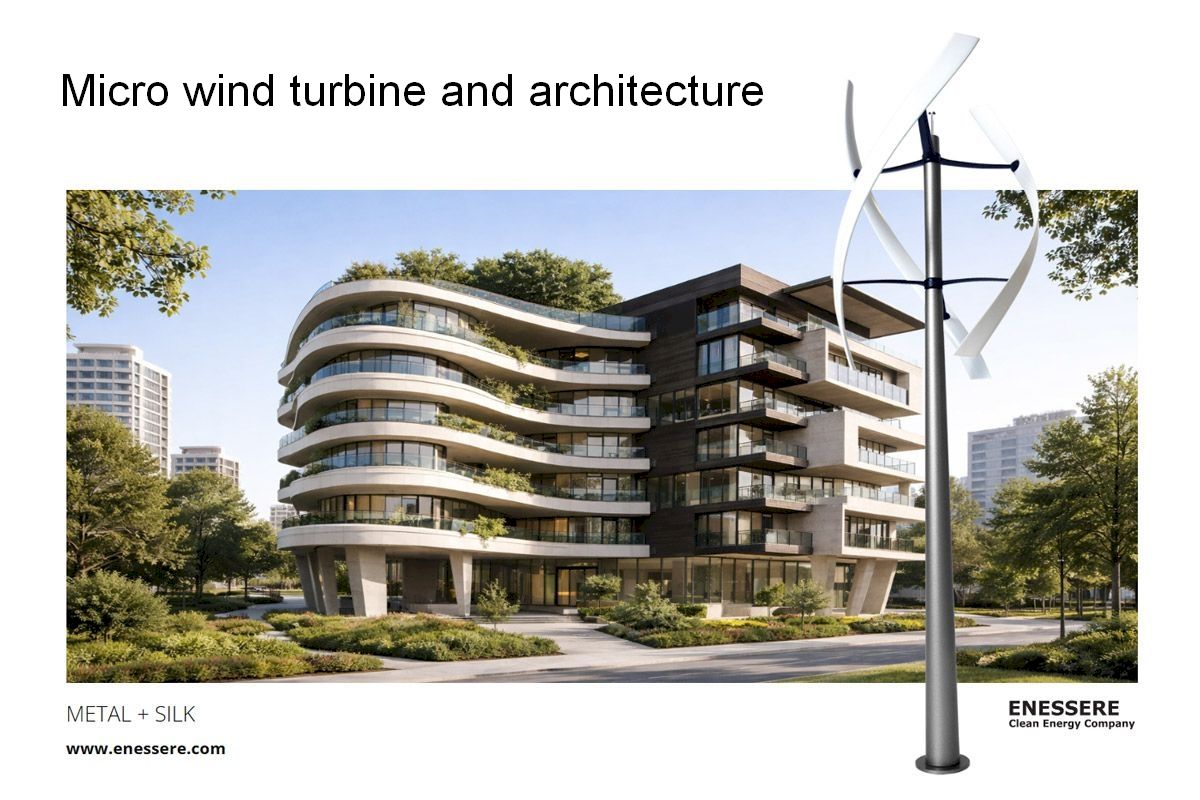
Enessere, a design micro wind turbine for modern architecture
The integration of micro wind turbines into contemporary architecture has always been an aesthetic and design problem for designers and architects. For decades, domestic wind turbines have been perceived as elements alien to architectural language, difficult to justify aesthetically and often a source of visual and acoustic disturbance in buildings.
This difficulty has limited the spread of renewable energies integrated into building projects, despite the growing demand for sustainable solutions and the urgency of the energy transition.
Enessere has developed a radically different approach: a design-driven vertical micro wind turbine conceived from the outset as an architectural element, not as a technical infrastructure to be concealed.
Micro wind turbines as a design problem. Until Enessere changed perspective
For a long time, micro wind turbines were perceived as a design problem. Not as a resource, but as an element to justify, to hide, or to relegate to the margins of the project. Not because they were connected to wind power, but because they had never been conceived as architecture.
Traditional solutions often introduced visual and acoustic disturbance, broke the proportions of buildings and imposed constraints instead of generating opportunities. The result was a technical object extraneous to the language of the project, difficult to integrate and, in most cases, hard to defend from an aesthetic standpoint.
Enessere was born from the opposite vision
Enessere does not start from the idea of hiding technology, but of giving it a clear, intentional and recognizable architectural form. Enessere micro wind turbines are not infrastructure to be concealed, but vertical elements designed to be seen, objects drawn according to harmonious proportions, capable of dialoguing with the context in which they are placed.
Each Enessere turbine does not dominate the landscape, instead it enters into a relationship with it.
It becomes a legible sign of sustainability, an element that adds value to a project rather than compromising it.
It does not ask architecture to adapt to technology: it is technology that puts itself at the service of the project, thanks to a high level of chromatic customization and the use of valuable materials such as Paulownia wood.
For this reason, Enessere represents a change in perspective: a micro wind solution that architects can finally use as an integral part of their design language.
Form and performance
Enessere wind turbines combine harmonious proportions with certified performance, with power outputs in the domestic micro wind range (up to 20 kW). The compact vertical dimensions allow installation on residential, commercial, and public buildings without altering architectural proportions, while the reduced acoustic emissions ensure living comfort even in dense urban contexts.
Vertical-axis technology enables omnidirectional wind capture, particularly advantageous in built environments where airflow is variable and turbulent.
Paulownia wood: sustainability and lightness
Paulownia wood is one of the distinguishing materials of Enessere turbinesand it was chosen for its exceptional mechanical and aesthetic properties. With a strength-to-weight ratio superior to many synthetic composites, Paulownia offers structural lightness and long-term durability, minimizing the impact on building statics.
Its natural resistance to weathering and its ability to absorb CO₂ during growth – up to 10 times greater than other tree species – make it a choice consistent with the principles of sustainable architecture and low environmental impact design.
Customization: each project, its own turbine
Enessere offers a high level of chromatic and material customization, allowing architects to integrate wind turbines into the design concept from the earliest stages. The blades can be produced in various RAL finishes, natural textures, or with surface treatments that dialogue with the architectural language of the building.
This flexibility transforms an integrated micro wind turbine from a standardized element into a specific design component, capable of enhancing the visual identity of the architectural intervention and responding to landscape constraints or contextual requirements.
Beyond energy: added real estate value
Buildings equipped with integrated renewable energy production systems register higher value appreciation compared to conventional buildings. Well-integrated wind turbines represent a tangible element of sustainability, immediately perceived by buyers and tenants sensitive to environmental issues. The energy class upgrade resulting from self-production reduces future operating costs and makes the property more competitive in a market increasingly oriented toward energy efficiency standards and the reduction of CO₂ emissions.